Project Overview
This is a custom-designed compact robot controller board powered by the ESP32-S3-WROOM-1U SoC, developed specifically for a compact autonomous secondary robot (SIMA) in the Eurobot international robotics competition.
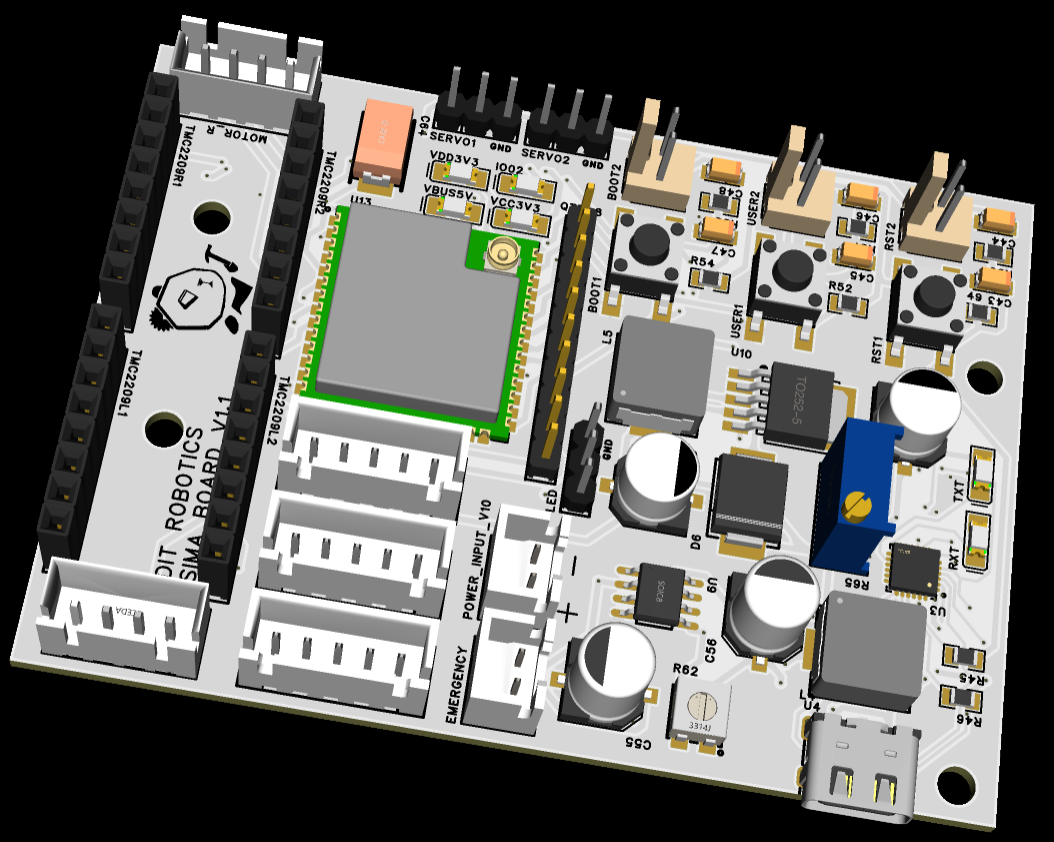
Secondary robots in competition face strict envelope volume and weight restrictions. Rather than stacking commercial microcontrollers with external shield boards, I consolidated the processor, dual stepper motor drivers, dual Buck/Boost power regulators, and distance sensing interfaces into a single 81mm × 59mm form factor.
Technical Specifications
- Microcontroller SoC: ESP32-S3-WROOM-1U-N16R8 (Dual-core 32-bit LX7, 240MHz, 16MB Flash, 8MB PSRAM)
- Wireless Connectivity: External U.FL antenna connector ensuring stable WiFi/BLE communication through metallic robot chassis shields
- Dimensions: 81mm × 59mm
- Motion & Actuation:
- 2x TMC2209 silent stepper motor driver interfaces for silent and smooth motion control without external feedback
- 2x Servo motor PWM outputs
- Dual Power Management:
- XL1583 Buck regulator (providing stable logic power)
- XL6008 Boost regulator (supplying flexible stepped-up actuator power)
- Perception Interfaces: 3x VL53 Time-of-Flight (ToF) laser distance sensor ports
- Programming: Onboard CP2102 USB-to-UART bridge with auto-programming boot/reset circuitry
Schematic & Thermal Layout Strategy
Integrating high-heat TMC2209 drivers alongside dual switching regulators in an ultra-compact footprint required rigorous layout partitioning. Ground planes and switching nodes were partitioned carefully to isolate high-frequency motor switching noise from the sensitive ESP32 RF circuitry and analog rails.
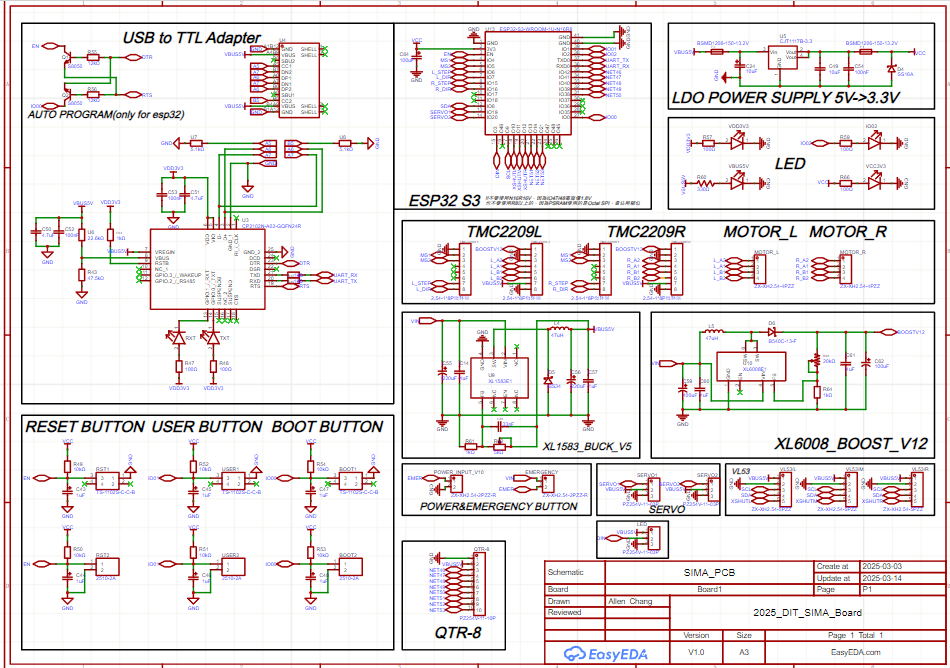
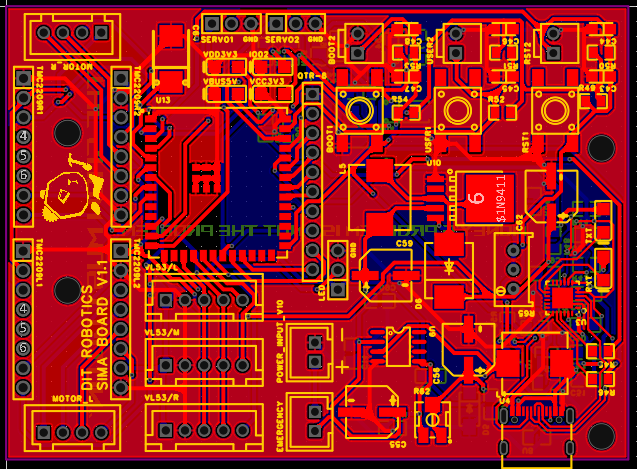
Click on any image above to open the full-screen PhotoSwipe lightbox for high-resolution inspection.
Hardware Prototyping & 3D Verification
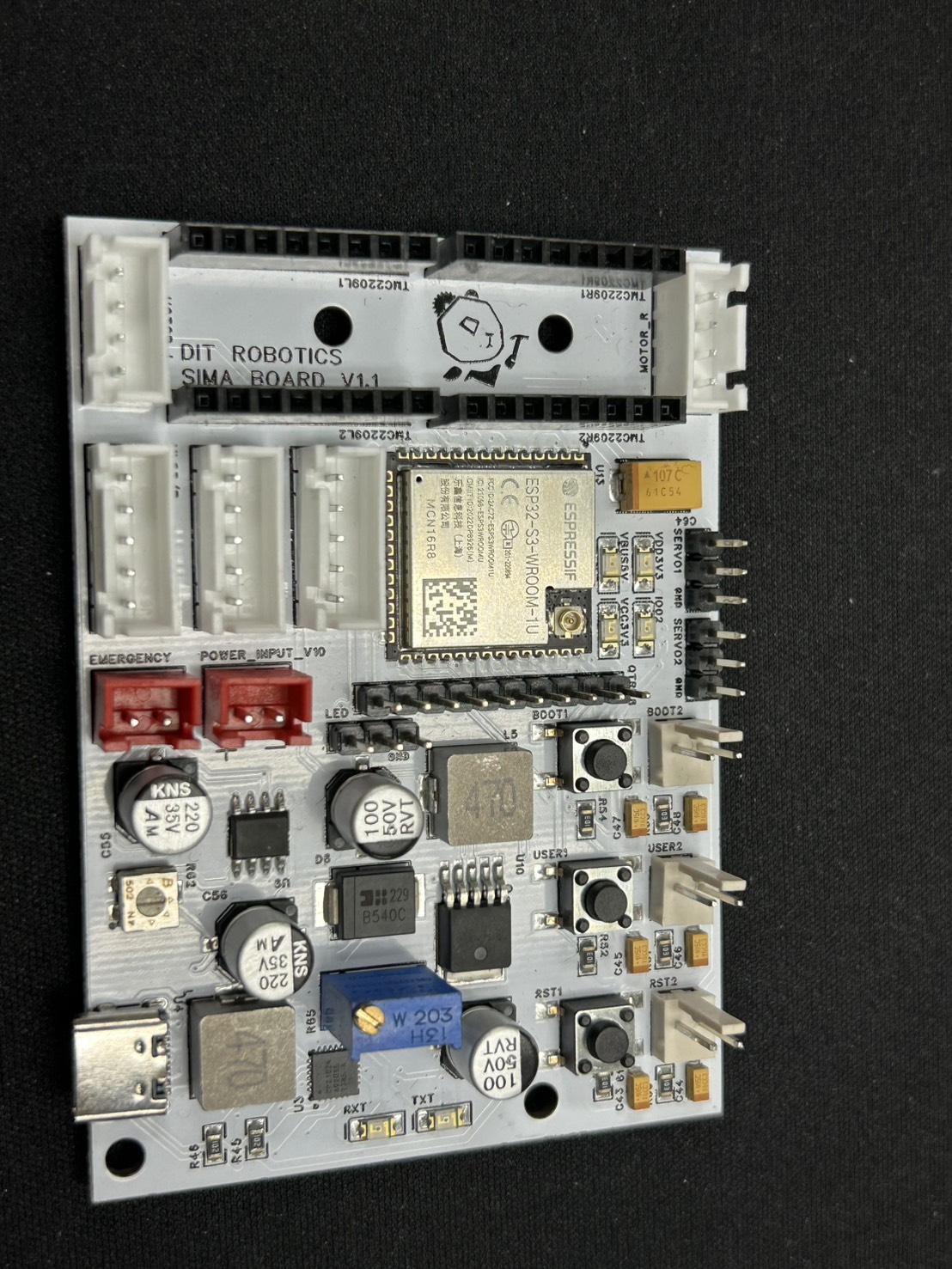
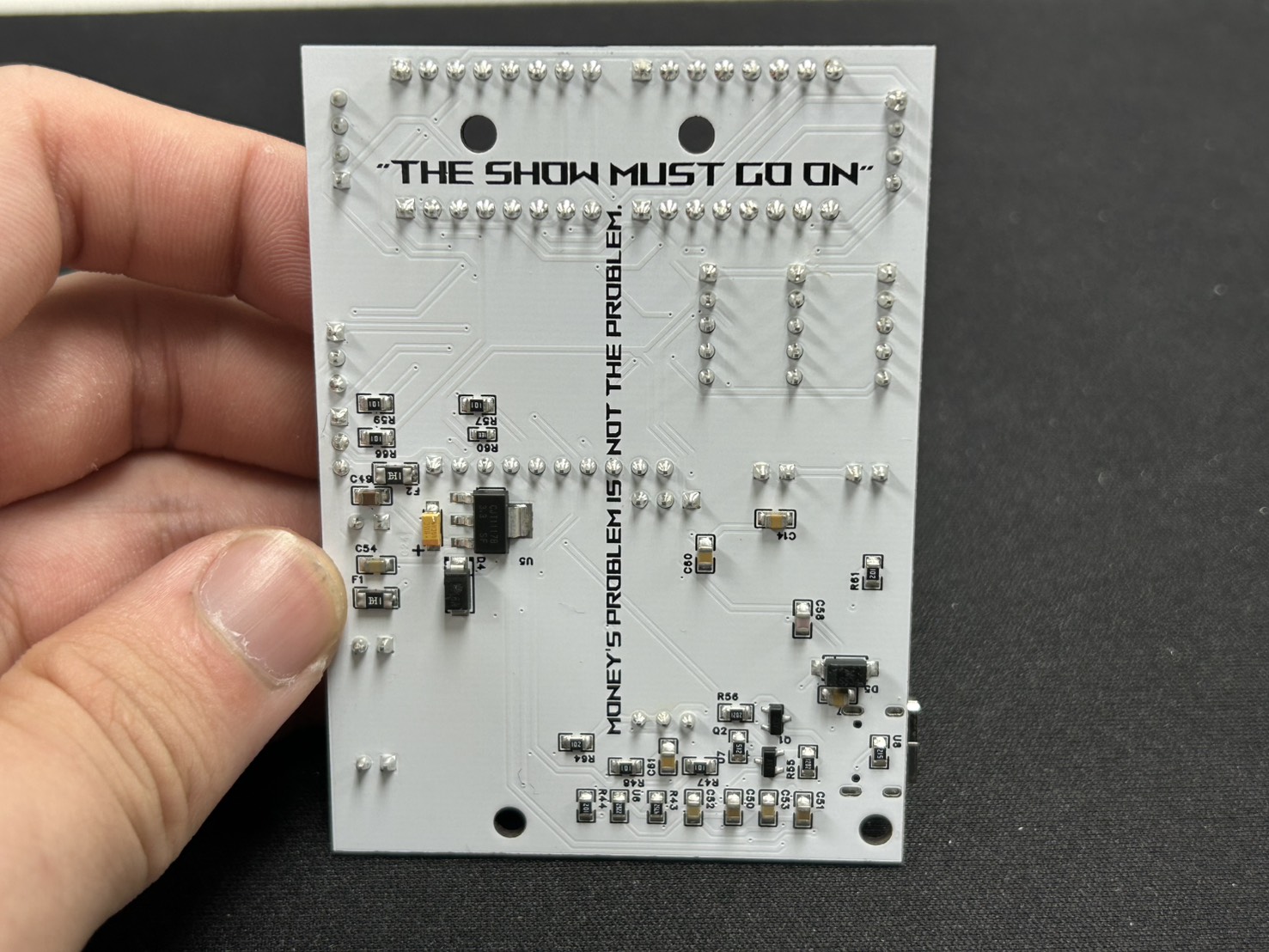
Prior to fabrication, full 3D CAD clearances were verified against the chassis enclosure. Initial prototypes were assembled via manual hot-plate reflow soldering to validate component footprints and driver communications.
Advantages Over Off-the-Shelf Solutions
- Monolithic Integration: Eliminates messy DuPont jumper wires, preventing vibration-induced loose connections on the tournament field.
- Smooth Open-Loop Precision: TMC2209 micro-stepping enables smooth and repeatable wheel movement without requiring bulky external optical encoders.
- External RF Antenna: Overcomes radio signal attenuation caused by competition metallic frame elements.
Open Source Repository
The complete schematic and PCB layout design files (EasyEDA Pro) are open source:
- OSHWLab Repository: 2025_dit_sima_board Project Link